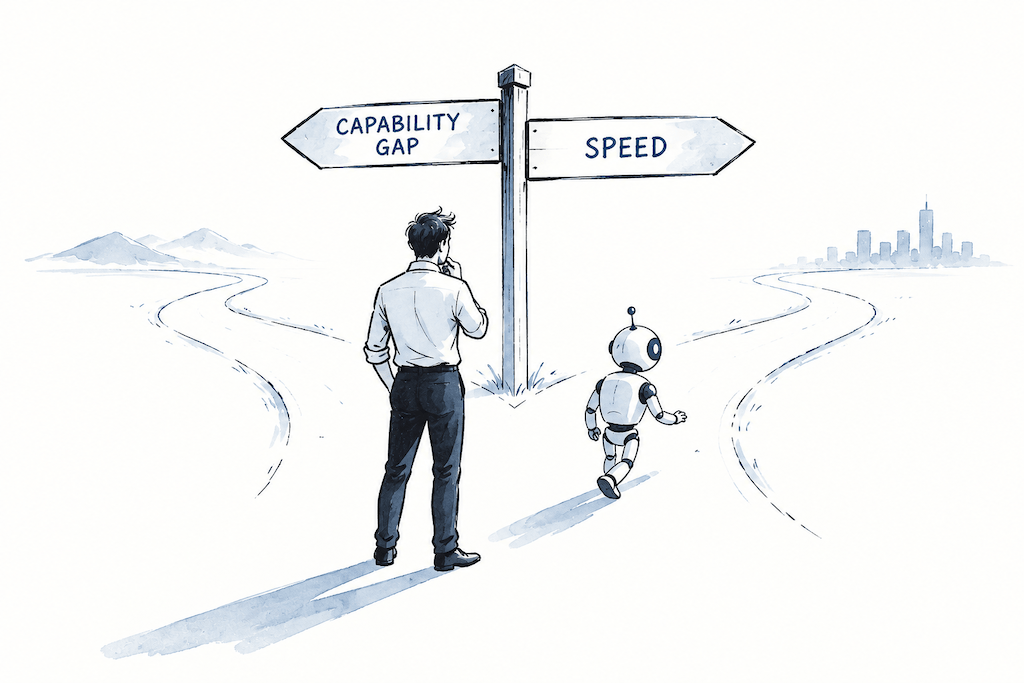
After joining Imperial, I came across someone whose approach immediately stood out. It was about the way she took complex, unfamiliar topics, quickly make sense of them, build a clear and compelling narrative around them. What also impressed me are the speed and quality of the work, also the analytical thinking, focus on the clarity as well as the story behind it. What we are doing, why it matters, how it connects to the bigger picture and, most importantly, how it can be explained in a very simple way so others, and here “others” mean senior stakeholders, can understand the key aspects rapidly.
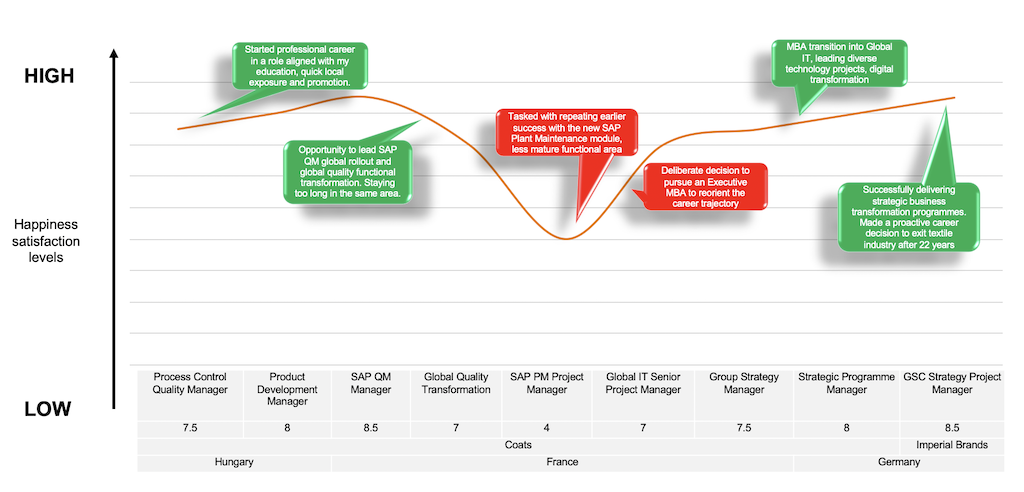
After a short hesitation I asked her to mentor me for 6 months. Now fast-forwarding to the third session where we focused on something that sounds almost too simple to be useful: career happiness. The idea was to look back across my career and assess, focusing on main periods, how satisfied and happy I actually was, and more importantly, to understand what was driving that feeling. The approach itself is based on a simple but powerful assumption: by reflecting on what you truly enjoyed in the past, you can make better decisions about the kind of work you should pursue in the future.
Side note: This reflection also connects closely to the idea of the Japanese Ikigai, which sits at the intersection of what you enjoy, what you are good at, what the world needs, and what you can be paid for. Looking at your career through the lens of happiness might helps better understand where those elements naturally come together.
The exercise had two parts. First, mapping the different stages of my career and assigning a level of satisfaction/ happiness to each of them. Second, analyzing the types of activities and capabilities that were present in those periods, and identifying which ones I genuinely enjoyed. Not from a performance perspective, not from a “what am I good at” angle, but from a much more personal question: what gave me energy?
To be fully honest, the outcome was not surprising. I did not suddenly discover something completely new about myself. But that does not mean the exercise was not valuable. Quite the opposite. What it gave me was confirmation, and confirmation is often more powerful than discovery. I actually enjoyed spending some time on this self-reflection.
Before joining Imperial, during the interview period, I had already gone through a fairly deep reflection process. Leaving a company after more than twenty years forces you to do that. I had spent time thinking about where I made the right decisions, where I might have stayed too long, and where I lost alignment or integrity with my own standards. I also reflected on the moments where I actively shaped my career instead of just following what was in front of me. This exercise brought all of that together in a much more structured way.
Looking across my career, the pattern is actually very consistent. I am at my best, and I enjoy my work the most, when I can connect strategy with execution. When I can take something complex and ambiguous and bring structure, clarity, and direction to it. I enjoy working in environments where there is no obvious answer and where progress depends on asking the right questions and aligning the right people.
I also realized, once again, how much I value the human side of the work. I am not the type of person who dominates the room, but I tend to be the one who makes the room function. I enjoy bringing people together, creating alignment, and helping teams move forward. There is a certain satisfaction in being the person who quietly ensures that things actually get done.
Another strong theme is ownership. I enjoy stepping into gaps, taking responsibility, and driving things forward without needing constant direction. And I consistently find more motivation in international, cross-cultural environments, where different perspectives naturally create a richer way of thinking.
One interesting reflection from this exercise is the relationship between skill and enjoyment. I knew it already, in most cases, there is a clear correlation: the better you are at something, the more you enjoy doing it. But there are exceptions: occasionally, you find yourself doing something you are not particularly strong at yet, and still enjoying it. Those are the passion points and, in my view, is worth paying attention to. It can be an early signal of something that could develop into a real strength over time.
One general takeaway from this exercise: do not look at your career only through the lens of skills, experience, or progression. Those are important, but they do not tell the full story. Try to understand what actually makes you enjoy the work you are doing, because that is what will sustain you over the long term.
For me, this was not about discovering something new, but about reconnecting with what I already knew and putting it into a clearer structure. And that clarity is what helps when making decisions about what to pursue next, and just as importantly, what to avoid.
I am sharing this openly because I believe many of us go through similar questions, but we rarely take the time to structure our thinking around them. If this resonates with you, or if you have approached your own career in a similar way, I would be interested to hear your perspective!