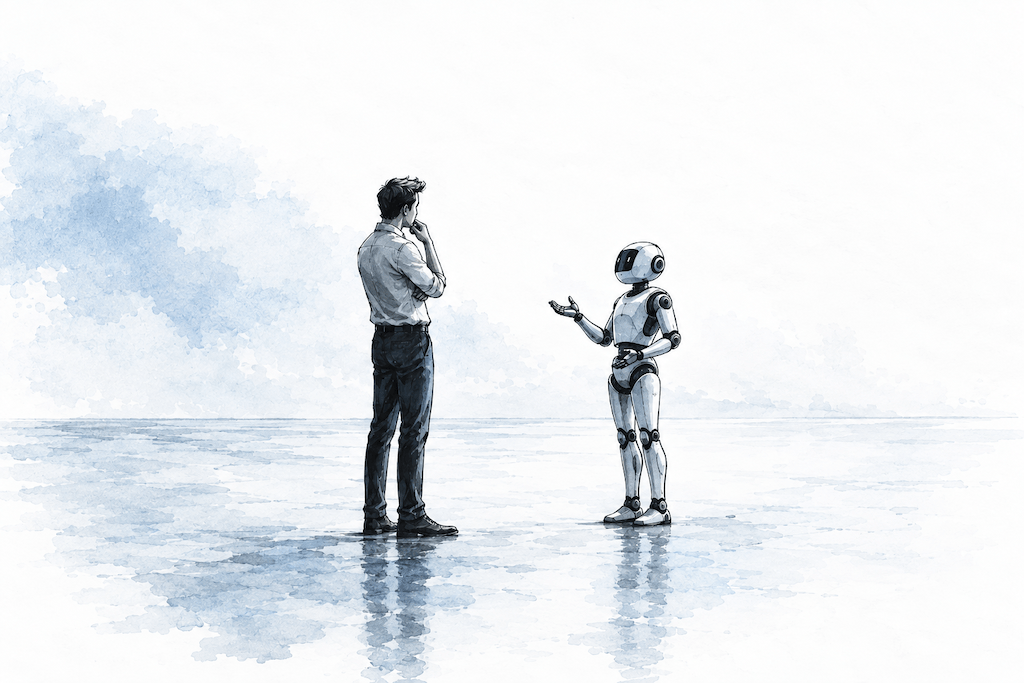
This is the first in a short series of posts about AI. I will stay deliberately close to everyday use: AI assistants such as ChatGPT or Copilot, and what happens when ordinary people start using them regularly at work and in their private lives. I am not going to speculate about artificial general intelligence, robots taking over the world or what the labour market might look like in 2045. There is enough to think and talk about already on this territory.
I use AI every day, don’t we all? I have spent a considerable amount of time over the past year experimenting with it, running workshops on prompting and trying to understand how to use it better. I am convinced of its value. But the more I use it, the more I think that some of its biggest risks are not particularly futuristic. They are already sitting quietly in the way we use it today. One of them is that AI makes it remarkably easy to do things we cannot actually do.
That sounds entirely positive, and often it is. But there is an important distinction between using AI to compensate for something we do not know how to do and using it to improve something we already can do.
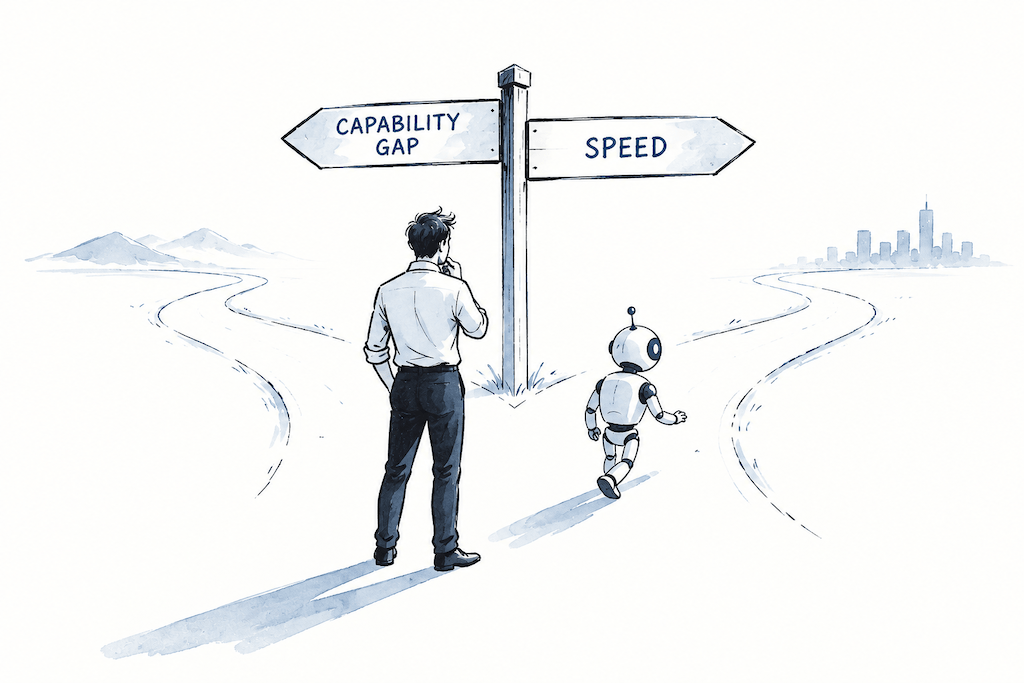
I recently heard Hungarian futurist, Árpád Rab discuss a similar distinction in a podcast. He described technology as something that can fill a capability gap or enhance a capability we already have. I have simplified the idea further for myself. When I use an AI assistant, I increasingly try to understand whether I am using it for a capability gap or for speed.
The capability gap is the more obvious risk. If I ask AI to do something I cannot do myself, it can give me access to a capability almost instantly. The problem is that I can easily confuse having access to a capability with actually having it.
If the missing capability is something I will need repeatedly, particularly in my professional life, that distinction matters. AI may be a perfectly good temporary bridge, but at some point I may need to close the gap myself. If I repeatedly outsource the same thinking or skill, I may become very efficient at producing the result without ever becoming better at producing it myself.
This morning provided a rather mundane example of when I think that is perfectly fine. I live in Germany and wanted to change my tax class. I contacted my tax adviser, whom I like very much and who has helped me enormously over the years. She told me she could take care of it and estimated about an hour of work. Her hourly rate is €290. I was perfectly prepared to pay it. Then I thought: it is 2026, I have ChatGPT, and it shouldn’t be that complicated to make, perhaps I should at least see whether I can do this myself?
I registered for the German tax portal, waited four or five days for the activation code to arrive by post and logged in this morning. With ChatGPT guiding me through the process, explaining what I was looking at and helping me when I was unsure, I completed the change in about an hour.
This was unquestionably a capability gap. I do not understand German tax administration well enough to have done it alone, and completing the process with AI did not make me a German tax expert. But that is fine. I have no ambition to acquire this particular capability. I needed to complete one administrative process correctly, and AI helped me do it. I saved €290 in the process.
Interestingly, I already know where that €290 went. On 8 October I am attending a McKinsey alumni event, so I used approximately the same amount booking the flight and making a hotel reservation. I effectively exchanged an hour of German tax administration for an experience I value considerably more. That seems like a very good use of AI to me.
The calculation becomes less comfortable when the capability gap is something I should actually close. If I use AI because my German is not yet good enough to write a difficult letter, for example, it solves today’s problem. If I use it to write every German letter for the next ten years, I may also be quietly removing one of the reasons I would otherwise improve my German. The technology has solved the immediate problem while potentially preserving the underlying one.
The second category looks safer but has its own trap. When we use AI for work we could do ourselves: reviewing a document, challenging an argument, structuring information, getting a second opinion or improving a draft. In those situations AI is enhancing an existing capability, and the most obvious benefit is speed. If something that used to take an hour now takes twenty minutes, I have gained forty minutes. The important question is what happens to that forty minutes?
The obvious answer in the workplace is often: more work. The forty minutes become another task, which AI also makes faster, creating space for another task after that, and so on. Productivity rises, but the working day does not become shorter and the person doing the work is not necessarily better off. Recent research and commentary are beginning to examine exactly this paradox: AI can reduce the time required for individual tasks while simultaneously increasing the volume and intensity of work.
- When AI compensates for a capability I do not have, I want to know whether that is a gap I am happy to leave open. German tax administration? Yes. A capability central to my profession? Probably not.
- When AI enhances something I can already do and gives me time back, I want to know what I intend to do with that time. Sometimes the answer may indeed be more work. But it could also be deeper thinking, learning something new, talking to someone instead of sending another email, exercising, reading, or simply finishing the day earlier.
AI assistants are already extraordinarily useful, that is precisely why I think we should pay attention to these questions now, while we are still developing our habits around them.